

Growth in the pest control industry is rarely a linear path. While the market is thriving—with industry revenue reaching $13.416 billion in 2025—the primary friction points for owners remain consistent: labor gaps, operational complexity, and the constant need to minimize callbacks. Overcoming these challenges requires a transition from “doing” the work to “managing” the systems that produce the work.
Solving Labor Constraints and Technician Retention
With nearly 37% of firms reporting that growth is constrained by a lack of technicians, your ability to recruit and retain talent is your most significant competitive advantage. Competitive pay is the baseline, but top-tier technicians today look for career pathways, not just jobs.
Building a robust recruitment funnel involves showcasing your company culture as much as your service quality. Implement structured training programs that turn novices into certified professionals, and offer performance-based bonuses that reward efficiency without sacrificing safety. When you treat your technicians as the face of your brand rather than just field assets, you reduce turnover and, by extension, the costs associated with constant re-hiring.
Standardizing Workflows with Field Management Software
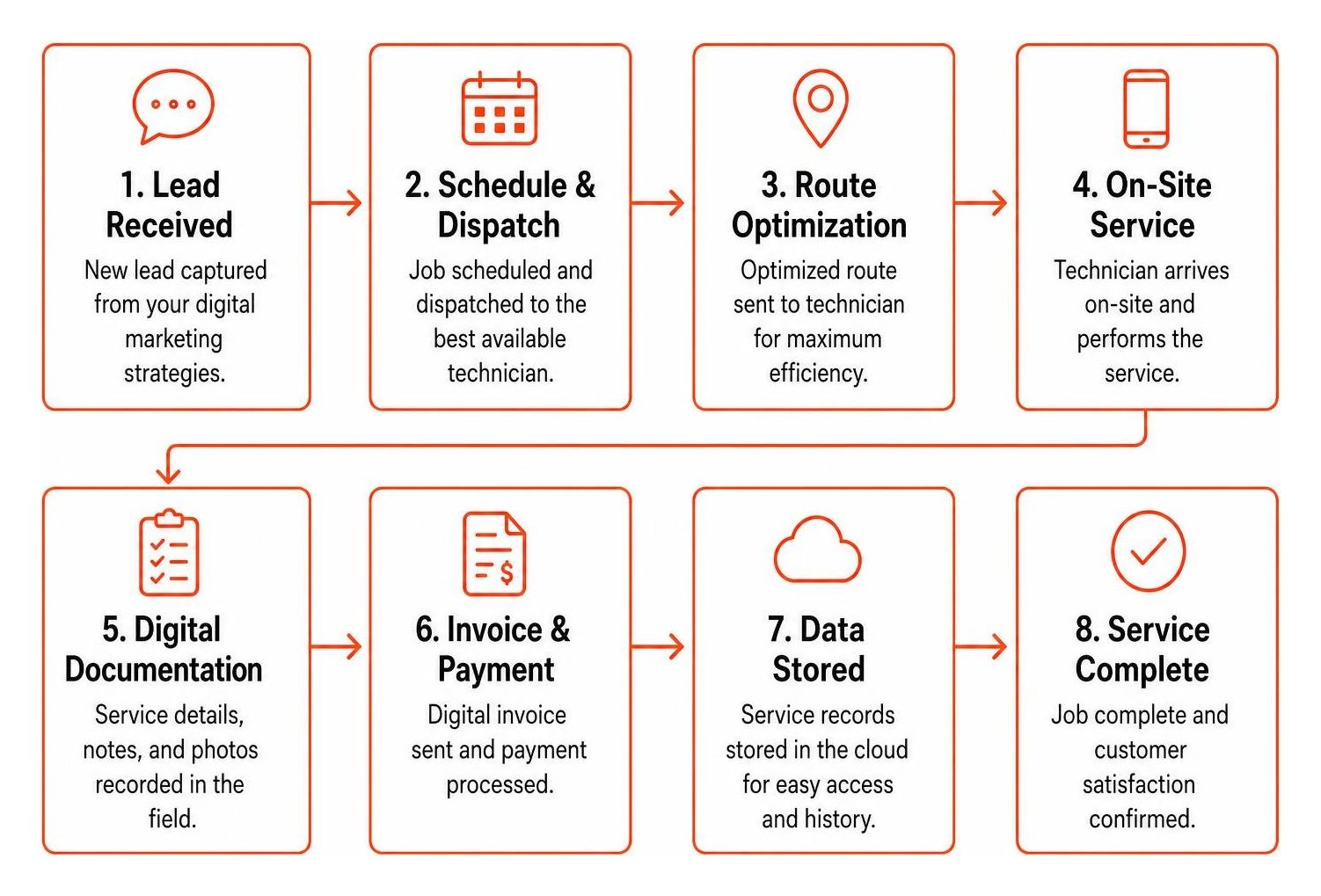
The most successful companies have largely moved away from manual scheduling and paper-based reporting. Adopting field service management software is no longer optional; it is the backbone of scalability. Platforms like GorillaDesk or FieldRoutes allow for automated dispatch, real-time GPS route optimization, and digital invoicing.
Furthermore, specialized tools for termite graphing, such as ArcSite, have revolutionized how businesses handle inspections. By moving to digital records, you eliminate the time lost to manual sketching and ensure that every technician has access to a cloud-based history of a property. This standardization ensures that a service performed by a new hire meets the same quality benchmarks as one performed by a veteran, significantly reducing the “ant and cockroach” callbacks that plague growing operations.
Proven Digital Marketing Strategies for Scalable Customer Acquisition
In an era where homeowners decide on a service provider within four hours of searching, your digital presence is your storefront. Relying on word-of-mouth is sufficient for a solo operation, but scaling requires a proactive, multi-channel approach. Implementing sophisticated digital marketing strategies is how you ensure your brand is the first one visible when a customer realizes they have a pest issue.
Core Digital Marketing Strategies for High-Intent Lead Generation
High-intent leads come from people actively searching for solutions. Local SEO and Google Business Profile optimization are your most powerful tools here. Ensure your NAP (Name, Address, Phone) information is consistent across every directory. When you combine this with geo-targeted Pay-Per-Click (PPC) campaigns and Local Services Ads (LSAs), you capture the “right now” traffic. By building landing pages specific to the pests you are targeting—such as bed bug eradication or mosquito control—you increase your conversion rates significantly compared to sending all traffic to a generic home page.
Integrating Digital Marketing Strategies with Reputation and Review Management
A 4-star rating is often the minimum threshold for trust in the modern market. Your digital marketing efforts will fall flat if your online reputation is weak. Integrate automated SMS follow-ups into your service workflow to request reviews immediately after a successful treatment. When you make review collection a standard part of the job, you build a “reputation moat” that makes it incredibly difficult for competitors to displace you.
Maximizing Profitability and Recurring Revenue Models
The secret to a high-valuation pest control company is the shift from transactional one-off jobs to a recurring revenue model. In 2025, recurring revenue accounted for over 85% of residential service revenue across the industry. This model provides the predictable cash flow necessary to fund expansion and invest in better equipment.
Optimizing Route Density and Reducing Windshield Time
Profitability in this industry is tied directly to “windshield time.” The more time your technicians spend driving, the less they spend treating homes. Route density—the practice of clustering your customers within specific neighborhoods—is a massive profitability lever. Use your CRM to identify high-density zones and focus your marketing efforts specifically on those areas. When you can increase your daily stop volume by even one or two stops per technician, you see a direct, positive impact on your operating margins.
Upselling Eco-Friendly and Specialized Pest Control Services
Diversification is the best way to smooth out seasonal demand. While general pest control provides the base, upselling specialized services like wildlife removal, heat treatments for bed bugs, or eco-friendly Integrated Pest Management (IPM) allows you to increase your average ticket size. Modern homeowners are increasingly value-driven, and offering “green” options can be the differentiator that wins you a contract over a lower-priced, chemical-heavy competitor.
Feature Residential Subscription Commercial Contract Revenue Type Recurring, predictable Recurring, variable Primary Goal High-volume, low-churn High-value, long-term Marketing Focus SEO & Reviews B2B Networking & Referrals Scaling Beyond Your First Location: Systems, Team, and Geographic Expansion
Expanding beyond your first location is where most businesses face the “growth wall.” To successfully scale, you must move from a centralized decision-making model to a decentralized one supported by rigorous Standard Operating Procedures (SOPs).
Developing Standard Operating Procedures for Multi-Branch Quality
Quality control is the biggest risk during expansion. You need digital auditing tools that allow you to review service checklists remotely. Whether you are using the EOS (Entrepreneurial Operating System) framework or your own proprietary management structure, ensure that every branch manager has a clear playbook for hiring, training, and service delivery. Brand consistency is maintained through documentation; if it isn’t written down, it doesn’t exist.
Building Strategic Referral Partnerships with Real Estate and Property Managers
Your best sales team often doesn’t work for you. Real estate agents and property managers are constant sources of leads, as they are the first to know when a property has a pest issue or is changing hands. Develop a formal referral program that provides value to these partners—such as rapid-response “code red” inspections—and you will create a steady, cost-free stream of high-quality leads that can support your expansion into new territories.
Frequently Asked Questions about Pest Control Growth and Marketing
What is the most effective way to scale recurring revenue in pest control?
The most effective method is to transition all one-time customers into subscription plans at the point of sale. Use automated billing to remove friction and offer quarterly or monthly service packages that include proactive inspections. Retention is higher when customers perceive the service as a “maintenance” necessity rather than an “emergency” fix.
How can pest control companies overcome technician hiring shortages?
Focus on building a “grow your own” culture. By creating an apprenticeship program, you can hire for attitude and train for skill. Pair this with modern technology; when technicians use intuitive, mobile-first software, they feel more professional and supported, which improves job satisfaction and retention.
What profit margins should a growing pest control business target?
While gross profit margins for the industry generally range from 10% to 20%, efficient, well-run firms often see operating profit margins between 20% and 45%. To hit these higher benchmarks, you must obsessively track your direct labor costs and chemical usage while leveraging technology to reduce administrative overhead.
Conclusion
Scaling a pest control business is a journey of operational discipline. By embracing technology to manage your routes, investing in digital marketing strategies to capture high-intent leads, and focusing on the recurring revenue models that provide stability, you can transform your operation into a market leader. The industry is growing, and the demand for professional, reliable service is higher than ever. With the right systems in place, you are not just killing bugs—you are building a sustainable, high-value enterprise that serves your community for years to come.