

The value of your business is not merely a reflection of your current balance sheet; it is a measure of your company’s ability to generate cash flow and operate independently of its founder. When an owner lacks a formal succession plan, potential buyers—and even internal stakeholders—perceive a massive “key-person risk.” This uncertainty acts as a discount on your valuation.
A 5-10 year planning horizon is the gold standard for a reason. It allows you to transform the business from a founder-centric operation into a professionalized entity that functions regardless of who holds the title of CEO. This timeframe provides the necessary runway to mentor successors, optimize operational processes, and clean up the corporate structure.
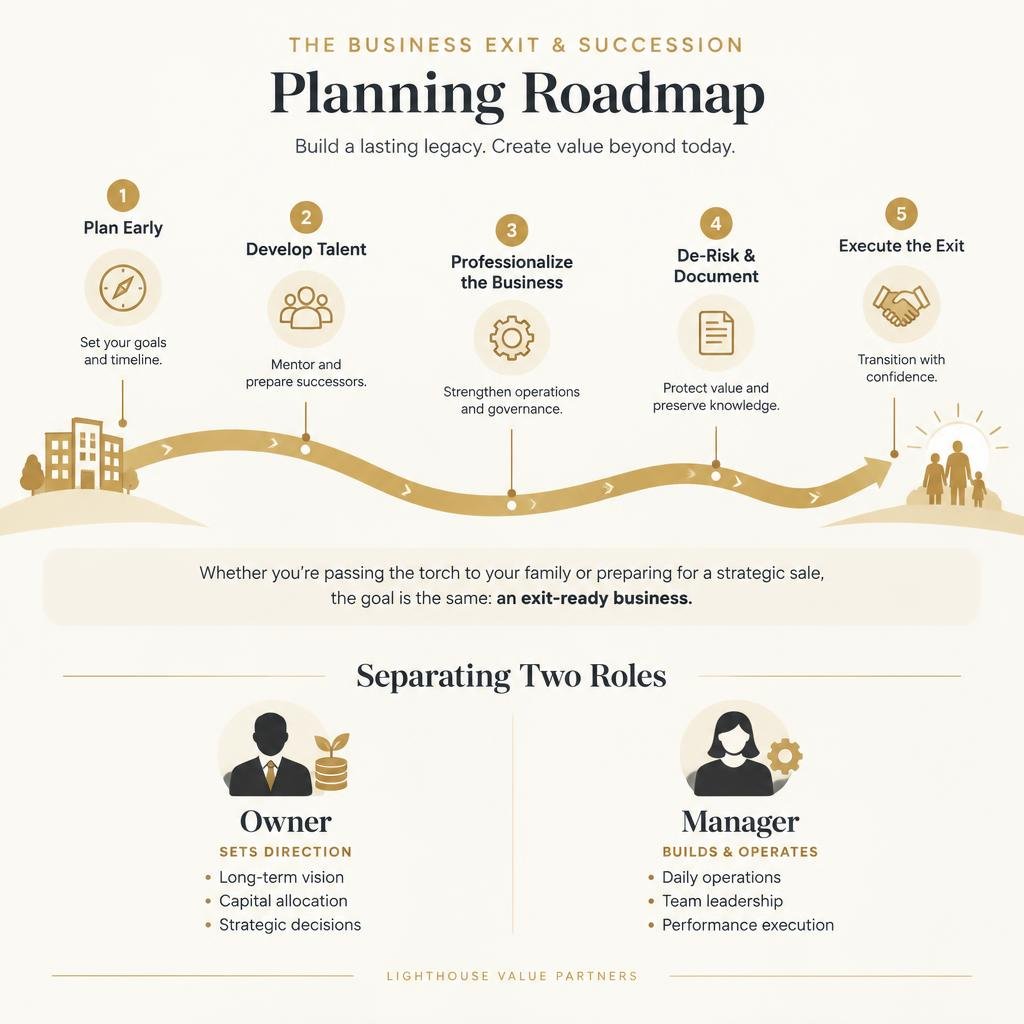
When we compare internal family transitions against third-party exits, the core requirement remains the same: the business must be “exit-ready.” Whether you are passing the torch to your children or preparing for a strategic sale, the process involves de-risking the organization, documenting institutional knowledge, and aligning the company’s strategic goals with the long-term vision of the future owners.
Separating Leadership Transition from Ownership Transfer
One of the most common mistakes in family enterprises is conflating the role of “owner” with the role of “manager.” These are two distinct functions that require different skills and carry different responsibilities.
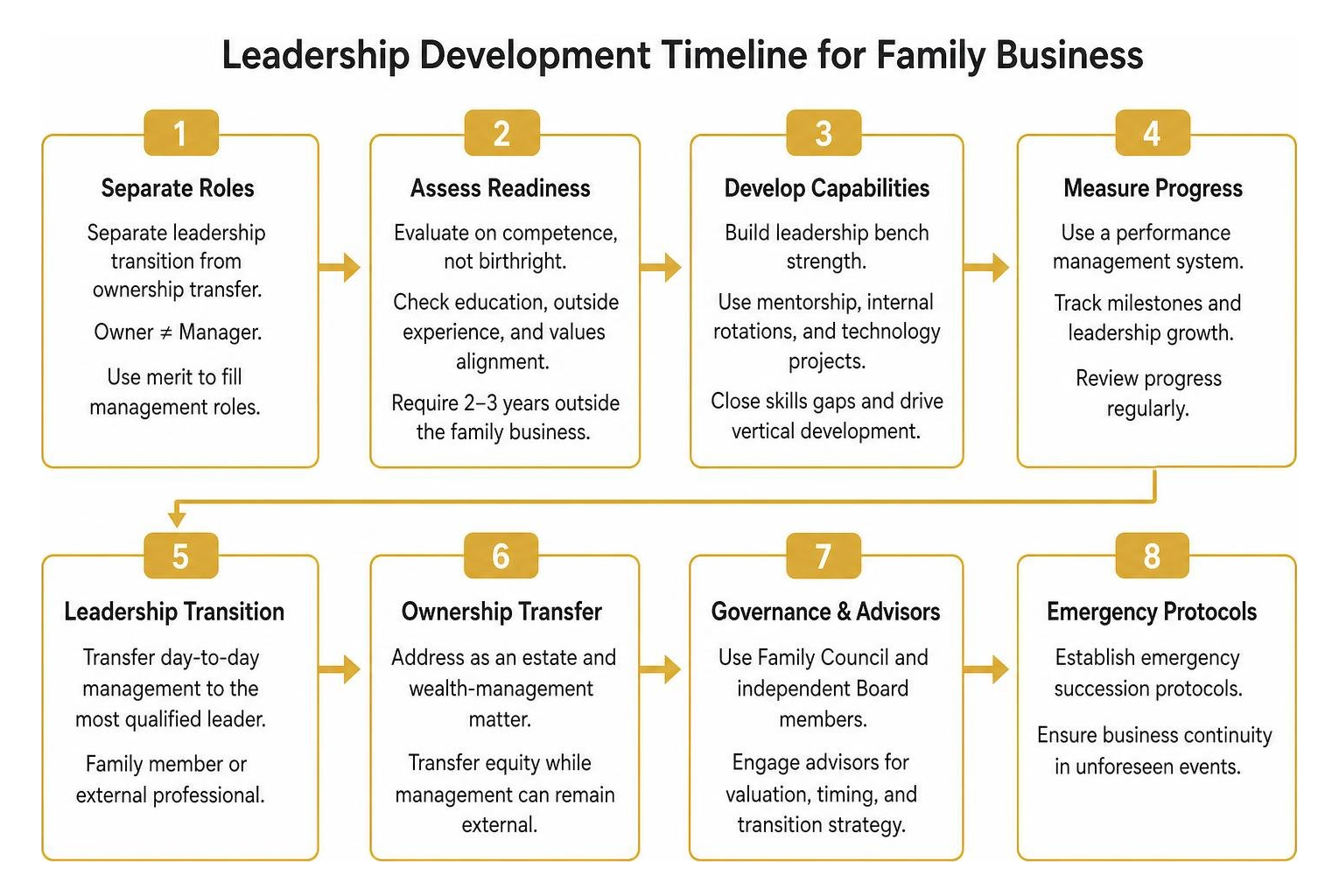
Management succession involves the day-to-day operation of the business. This is a meritocratic role that should be filled by the most qualified individual, whether that is a family member or an outside professional. Ownership transfer, conversely, is an estate and wealth-management issue. You can transfer ownership equity to your children to preserve family wealth while simultaneously hiring an external CEO to manage the business. By separating these two, you avoid the trap of “entitlement-based” leadership, where a family member is placed in a high-stakes management role simply because they hold equity.
Assessing Readiness and Mitigating Intergenerational Wealth Loss
Statistics show that 70% of families lose their wealth by the second generation, and 90% lose it by the third. This catastrophic erosion of value is rarely due to market conditions; it is almost always due to a lack of preparation.
To mitigate this, families must conduct a rigorous readiness assessment. This involves evaluating the next generation not on their birthright, but on their competence. Do they have the necessary education? Have they gained meaningful experience outside the family business? Are they aligned with the core values of the company? By requiring outside experience—often two to three years at a non-family firm—you ensure that the next generation brings fresh perspectives and proven professional capabilities back to the family enterprise.
The Role of Business Exit Strategy Advisory in Maximizing Transition Value
Navigating a transition is a high-stakes endeavor that often involves complex tax, legal, and emotional variables. This is why many owners turn to the private-business advisory sector for guidance. Professional advisors act as the “objective third party” that can facilitate difficult conversations, provide accurate business valuations, and ensure that the transition strategy is built on data rather than sentiment.
Engaging Business Exit Strategy Advisory for Valuation and Timing
An objective baseline is the foundation of any exit strategy. Before you can plan a successful transition, you need to know exactly what the business is worth. Professional advisors help you identify the “value drivers” that will increase your valuation multiple—such as recurring revenue streams, diversified customer bases, or proprietary technology. Furthermore, they can assist in structuring the deal to minimize tax exposure and ensure that the transfer of assets aligns with your broader estate planning goals.
Integrating Family Governance with Business Exit Strategy Advisory
Family governance structures, such as a Family Council or a Board of Directors with independent members, are essential for maintaining harmony during a transition. A Family Council provides a forum to discuss family values and expectations, while an independent Board of Directors focuses on the business strategy and holds management accountable. By incorporating independent perspectives, you prevent the “groupthink” that often plagues family-only boards and ensure that decisions are made in the best interest of the business’s long-term sustainability.
Structured Framework for Preparing Your Business for Exit
A successful exit is the result of a disciplined, phased approach. You cannot simply decide to exit and expect the business to be ready overnight. You must build a framework that includes clear milestones, documented operational procedures, and a performance management system that tracks the progress of potential successors.
Building Leadership Bench Strength and Next-Gen Capabilities
Developing the next generation requires a commitment to “vertical development”—moving beyond simple training to focus on leadership maturity. Use a skills matrix to identify gaps in your current leadership team and fill them through mentorship, internal rotations, and targeted technology modernization projects. When the next generation leads a digital transformation or a new product launch, they gain the credibility and experience required to eventually take the helm.
Establishing Emergency Succession Protocols
A significant percentage of business owners face unexpected health crises before their planned retirement. Without an emergency succession plan, a sudden departure can lead to a leadership vacuum, panic among key employees, and a rapid decline in enterprise value. Your emergency plan should clearly name an interim leader and outline the decision-making authority for the board. Key-person insurance should also be in place to provide the liquidity necessary to manage the business through the transition period.
Critical Pitfalls That Derail Business Exits and Succession
Even with the best intentions, many families fall victim to common traps. The most dangerous of these is “founder syndrome”—the inability or unwillingness of the current leader to relinquish control. When a founder remains involved in day-to-day decisions long after a successor has been named, it creates confusion and undermines the new leader’s authority.
Overcoming Founder Control and Decision-Making Paralysis
To avoid this, founders must transition from an operational role to a board-only role. This move allows the founder to provide strategic guidance and mentorship without interfering with the daily execution of the business plan. Establishing clear governance boundaries is the only way to ensure that the transition of authority is genuine and effective.
Addressing Non-Family Executive Retention and Equity Incentives
Your business is only as strong as its team. If your key non-family executives feel that their career path is blocked by family members, they will leave. To retain top-tier talent, you must offer competitive compensation packages, including phantom equity or long-term incentive plans that reward them for the company’s success. Transparency is key here; inform your executive team about the long-term vision for the business so they feel like partners in the transition rather than bystanders.
Frequently Asked Questions About Business Succession and Exits
When should a company start preparing for an exit or succession?
You should start planning 5-10 years before your target transition date. However, an emergency succession plan should be created immediately, regardless of your timeline. Early preparation allows you to optimize your valuation and groom your successors without the pressure of a looming deadline.
How do owners balance family fairness with business competence?
Fairness does not mean equality. You can treat your children fairly by ensuring they are all provided for through estate planning and non-voting equity, while reserving management roles and voting control for those who have demonstrated the competence and desire to lead. Compensation for family members working in the business should always be set at market rates to maintain the integrity of your financial records.
What options exist if internal successors are unready or unwilling to lead?
If your children are not the right fit for the business, you have several options:
- Professional Management: Hire a CEO to run the business while the family retains ownership.
- Management Buyout (MBO): Sell the business to your current management team.
- Third-Party Sale: Sell to a strategic buyer or private equity firm to maximize the cash exit.
- Employee Ownership (ESOP): Transition the business to your employees, which can offer significant tax advantages and preserve the company culture.
Conclusion
Succession planning is not a one-time event; it is a continuous strategic process that defines the future of your enterprise. By prioritizing professional governance, separating management from ownership, and seeking objective guidance from experts in the private-business advisory sector, you can ensure that your business remains a source of value and pride for years to come. The effort you invest today in building a robust, transparent, and professionalized organization is the greatest gift you can provide to your family, your employees, and your own legacy.